


For most of his career, Susheel Ladwa has operated at the intersection of healthcare, policy, and technology. But he will tell you that the biggest issue facing payers today is not regulatory pressure or innovation fatigue. It is something far more fundamental and far more fixable.
“Everything payers want to improve — quality, risk accuracy, care management, provider experience, prior authorization automation — it all comes back to one thing: the data,” he says. “If the data isn’t clean and connected, the entire system strains under the weight of bad information.”
And as AI becomes part of everyday payer operations, that foundation matters more than ever.
In an industry where technology investments are often measured in millions, Susheel Ladwa’s blunt clarity stands out. And it is that clarity that led him to build Onyx, a company focused on one mission: turning fragmented data into standardized, usable data that payers can trust, apply, and scale across their operations.
How Better Data Transforms the Way Payers Operate
When data is clean, connected, and reliable, the work of a health plan begins to look very different. Quality teams can run digital HEDIS without months of manual cleanup, giving them a near-real-time view of performance and the ability to act quickly on emerging trends. Risk adjustment becomes more accurate and timely, powered by standardized, usable data that shows a complete picture of each member rather than a fragmented one.
Care managers no longer need to stitch together information from multiple systems. Instead, they can see a unified, longitudinal view of each member, which supports earlier outreach, more informed guidance, and more meaningful touchpoints throughout the care journey.
For the first time, our customers can focus on improving outcomes instead of fixing the data required to achieve them. That shift changes everything, not just for operations but for the people they serve.
Even prior authorization, long slowed by inconsistent or incomplete data, starts to operate the way payers and providers have always hoped it would. Automated reviews become more reliable, turnaround times shrink, and the administrative burden on clinicians eases as decisions are supported by clear and consistent information.
And increasingly, these improvements create the conditions where AI can operate reliably rather than hypothetically.
“For the first time, our customers can focus on improving outcomes instead of fixing the data required to achieve them,” Susheel Ladwa says. “That shift changes everything, not just for operations but for the people they serve.”
The Origin of Onyx: Built to Unlock the Value Inside Payer Data
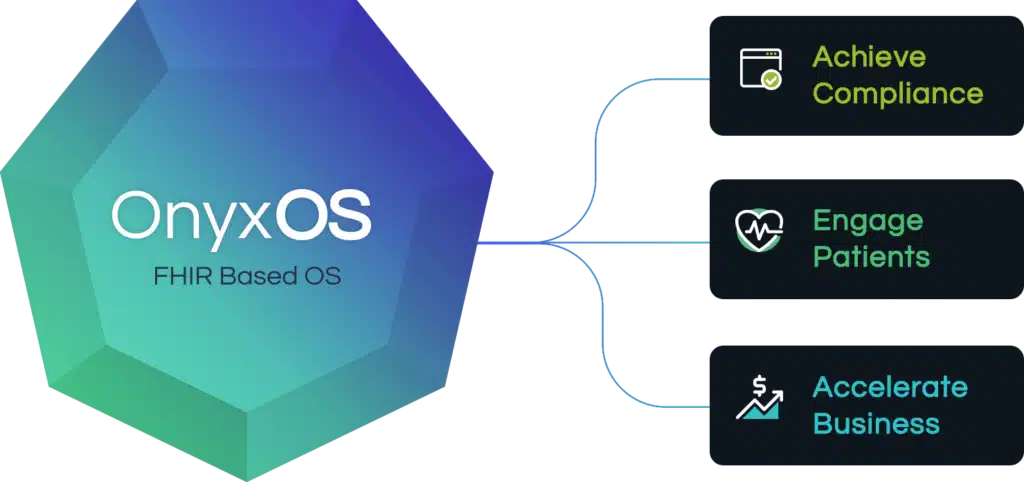 The idea for Onyx emerged long before regulatory deadlines began reshaping the industry. Customers kept saying the same thing: they wanted to make better decisions, intervene earlier, and automate more, but the data simply wasn’t ready.
“It became clear the real barrier was the data infrastructure underneath everything,” Susheel says. “Our customers needed a foundation they could rely on every day, across every part of their business.”
Rather than build another tool on top of fragmented systems, the team set out to create something more foundational. They built a platform centered on clean, connected data that could support the full arc of payer operations and bring coherence to information scattered across clinical sources, legacy platforms, and vendor ecosystems.
That vision guided the formation of Onyx. The goal was not to chase regulatory shifts, but to prepare customers for a future where data moves easily, supports decisions, and enables a more modern and intelligent way of operating.
CMS-0057 has accelerated the movement toward standardization, and Onyx was built to help payers turn that shift into lasting value by unlocking the full potential of their data, reliably and at scale.
Interoperability as a Catalyst for Value
For Susheel, interoperability is not a technology layer. It is an enabler of outcomes.
“When your data becomes standardized and usable, everything improves,” he says. “Quality becomes more accurate. Risk scoring becomes more timely. Care management becomes more proactive. Prior authorization becomes more automated. Providers get better, faster information. Members get a smoother experience.”
Healthcare is complex, but the mission shouldn’t be. We’re here to help payers operate more effectively, deliver better experiences, and access the value that has been locked inside their data for decades.
It is a cascading effect: clean, connected data leads to better operations, better decisions, and better outcomes.
And increasingly, it is also the prerequisite for AI tools that depend on clean inputs to deliver meaningful outputs.
This value-first framing is why so many payers transitioning to Onyx describe the experience not as a compliance lift, but as an operational transformation.
AI: The Future That Requires a Better Past
Every payer wants to harness AI, not theoretically but practically. They want intelligent prior authorization decisions, predictive risk models, early detection of care gaps, automated clinical review, and real-time analytics.
But Susheel Ladwa is quick to point out a reality that many overlook.
“AI doesn’t magically fix data. AI depends on data. If your data is inconsistent or fragmented, the insights will be too.”
This is where Onyx becomes essential.
By giving payers a foundation of standardized, usable data, Onyx enables AI to work as intended, accurately and at scale.
“AI is not the next step after interoperability,” Susheel Ladwa emphasizes. “AI is the reason interoperability matters.”
The company is already supporting payers who are integrating AI-powered workflows, running real-time analytics on FHIR-standardized data, and automating processes that were unthinkable just a few years ago.
Leadership With Purpose, Clarity, and Urgency
Susheel Ladwa is known for his crisp communication style and his ability to distill complexity into something operationally meaningful.
“Healthcare is complex, but the mission shouldn’t be,” he says. “We’re here to help payers operate more effectively, deliver better experiences, and access the value that has been locked inside their data for decades.”
His leadership approach is rooted in three principles: clarity over noise, speed over bureaucracy, and impact over activity. Teams inside Onyx often speak about his insistence on understanding the “why” behind every product decision. Customers feel that focus as well. Onyx’s success is built less on sales cycles and more on long-term partnerships.
A Future Built on Clean, Connected Data
Looking ahead, Susheel Ladwa believes healthcare is entering a new era, one where payers stop fighting their data and start using it to make smarter, more precise decisions.
“The future isn’t just interoperability for compliance,” he says. “It’s interoperability for value, for intelligence, and for care that is faster, more accurate, and more human.”
That belief extends directly into his view on AI.
“AI only becomes meaningful when the data underneath it is trustworthy,” Susheel Ladwa says. “The future isn’t more AI. It is better data feeding better AI.”
Onyx is already expanding its platform to power the next generation of analytics, automation, and AI across the payer ecosystem. What began as a company focused on interoperability is evolving into something larger: the data backbone that supports a more efficient, more insightful, more connected healthcare system.
“When we fix the data foundation,” Susheel Ladwa says, “we fix the system that depends on it.”
And for the first time in decades, that foundation is finally within reach.
Explore more articles:
Arthur L. Allen—Heidi AI: Equipping Students with Their Own Personal Supercomputers