





Arthur L. Allen, President and CEO of Adaptive Computing Enterprises, Inc., has a bold vision—to give every student access to their own personal supercomputer. His goal is to ensure that all students, regardless of economic background, have the tools to learn, create, and reach their full potential. What sets Allen apart is that he not only has the vision but also the technology to make it real.
For over two decades, Adaptive Computing’s Moab software has powered some of the world’s most demanding high-performance computing (HPC) workloads. Moab is an enterprise-grade orchestration platform used across aerospace, defense, research, and advanced manufacturing industries. It optimizes massive computational workflows—from computational fluid dynamics and drug discovery to molecular modeling and computer-aided engineering—ensuring top performance, scalability, and cost efficiency.
We’re very excited about bringing Heidi AI to all K-12 schools and higher education institutions in the United States, allowing all students to become proficient in creating AI models.
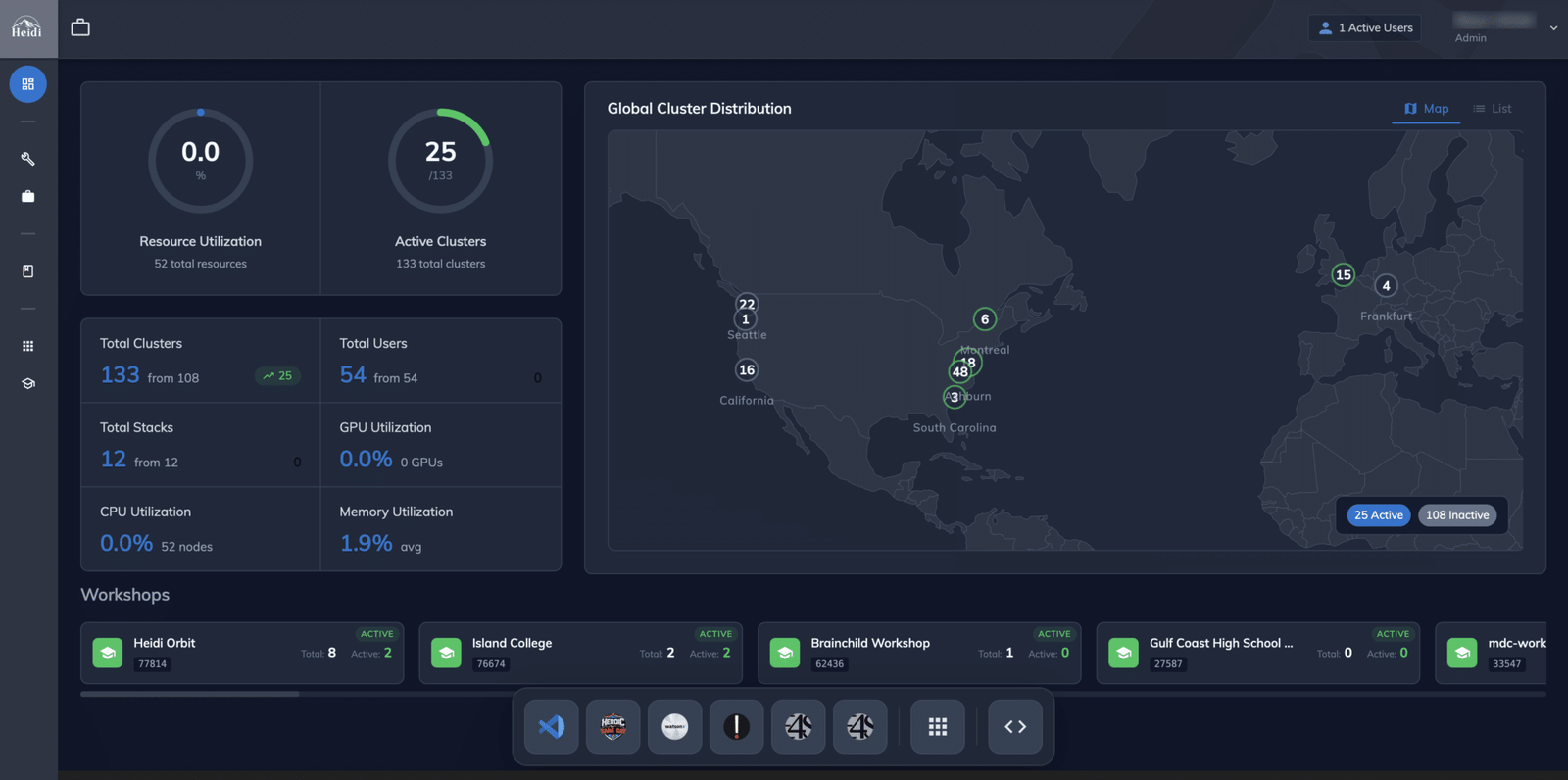
Building on this strong HPC foundation, Allen and his team have created Heidi AI, a browser-based supercomputing platform that brings the same powerful backbone used by enterprises into classrooms. Heidi AI uses all major cloud providers to host robust CPU and GPU environments powered by NVIDIA GPUs, optimized for deep learning, computer vision, robotics, and parallel processing. The platform supports secure access, dynamic scaling, and integration with Jupyter Notebooks and Python, enabling students and educators to run complex workloads seamlessly—the same type that research labs and enterprise R&D teams use daily.
Heidi AI: From Concept to Classroom
 Heidi AI is Arthur L. Allen’s brainchild—the product of more than forty years of experience building and scaling global software companies. His inspiration came from a simple but profound question: Why can’t students have the same computing power as researchers? He saw how most students and teachers are constrained by low-power laptops and Chromebooks, which cannot handle large-scale AI models, robotics simulations, or data science applications. Meanwhile, universities spend millions on supercomputers, which are typically reserved for research projects and seldom available for teaching or coursework. Even when GPU access exists, it’s often shared, limited, and scheduled, making it unreliable for hands-on curriculum use.
Heidi AI eliminates these barriers. It gives every classroom and student 24/7 browser-based access to GPU-powered supercomputing without any physical infrastructure. Students can now experiment, test, and deploy large AI models or robotics simulations freely, dramatically increasing engagement and practical skills. “Heidi AI gives every student access to their own personal supercomputer in the cloud,” says Allen. “We’re very excited about bringing Heidi AI to all K-12 schools and higher education institutions in the United States, allowing all students to become proficient in creating AI models.”
The platform comes with an intuitive interface, preloaded datasets, and over 150 open-source HPC and AI applications. It simplifies complex computing tasks, making advanced learning accessible to every student. Heidi AI also includes best-practice guides, visual examples of 3D scientific renderings, and curriculum templates to help educators integrate HPC and AI learning easily.
The results are transformative. Heidi AI ensures equity by providing all students equal access to high-performance computing. It builds workforce readiness, teaching the same tools and workflows used in AI, engineering, and cybersecurity industries. And it empowers teachers, removing the need for specialized IT skills to manage HPC resources. “From concept to classroom, Heidi AI delivers on the promise of equity, empowerment, and future-ready skills,” remarks Allen.
Heidi AI: Overcoming HPC Adoption Barriers and Making Supercomputing Affordable for Students
Arthur L. Allen, a former U.S. Marine Corps corporal who served during the Vietnam War, brings a mission-driven mindset to solving the challenges of HPC adoption in education. He recognizes that traditional on-premise systems are expensive, hardware-intensive, and require skilled staff to maintain. These barriers make HPC unaffordable for most schools. Heidi AI changes that completely. It operates entirely in the cloud, requiring no local hardware or installation. Students can log in through any browser on any device with internet access.
We have custom-built Heidi AI for K–12 classrooms and higher education—lightweight enough to run entirely in a browser, yet powerful enough to train machine learning models and simulate robotics in real time.
By leveraging all major cloud providers, Heidi AI avoids the high capital costs of local clusters while providing reliability, security, and global reach. “It is less expensive than a physical lab computer, costs less than a textbook per student, yet far more powerful,” says Allen. Institutions also pay only for what they use, making budgeting simpler and more predictable. Adaptive Computing offers academic pricing with flexible bundles for schools of all sizes.
Adaptive Computing manages backend support, uptime, and optimization, freeing teachers and administrators from IT burdens. Educators can create dedicated CPU/GPU clusters in minutes, pause or assign resources instantly, and ensure every student has consistent, unshared access. This direct access cuts computation time by up to 90 percent compared to traditional shared research queues. Heidi AI scales effortlessly from one student to hundreds, saving progress and data even when sessions pause or restart.
Heidi AI: Democratizing Supercomputing for K–12 and Higher Education
Already, five major U.S. universities have adopted Heidi AI, where it broke down walls between researchers and students by giving every learner their own dedicated GPU-powered workspace.
By providing accessible, cloud-based supercomputing resources, Heidi AI enables educators to integrate advanced computational tools into their curricula. Students can explore a wide range of real-world use cases and benefit directly from Heidi AI’s capabilities. In data science and AI, for example, they can train machine learning models, analyze large datasets, and develop data visualization techniques that prepare them for AI-driven careers. In biology and genomics, Heidi AI helps students study protein folding, DNA sequencing, and disease modeling using tools that merge biology with computational science. Its use cases are as broad as the workloads handled by traditional HPC systems. It’s designed to empower hands-on learning across K-12 and higher education, redefining what’s possible in modern education.
Adaptive Computing is rolling out Heidi AI across two-year and four-year colleges nationwide, focusing particularly on institutions without research-dedicated clusters. The company is also expanding into the K–12 segment, bringing supercomputing to high schools that offer AI and robotics programs. Arthur L. Allen aims to extend this supercomputing advantage to educational institutions worldwide, with partnerships already underway in Latin America, Canada, and Europe to support global STEM adoption.
Heidi AI: Pioneering the Next Frontier of Affordable Supercomputing
Arthur L. Allen continues to evolve Heidi AI with new modules, including cloud-based curricula for AI, cybersecurity, and robotics. He is also aligning with employers to bridge the gap between classroom learning and workforce demands. The next phase of Heidi AI will include a research-ready tier, allowing students and faculty to run real research workloads on the same platform.
“We have custom-built Heidi AI for K–12 classrooms and higher education—lightweight enough to run entirely in a browser, yet powerful enough to train machine learning models and simulate robotics in real time,” Allen says. “Our mission is to expand learning horizons by giving students their own supercomputers, preparing them for the future workforce or even their own entrepreneurial journeys,” he concludes.
Explore more articles:

As a seasoned professional with over a decade of experience in technology and business magazine publication, I’ve had a front-row seat to witness the astounding pace at which the industry has evolved, often outstripping even Moore’s Law. My passion lies in crafting engaging technology articles that invite readers to immerse themselves in the dynamic and ever-changing world of technology. With each piece, I strive to create a window into this world, offering a glimpse of the amazing events and breakthroughs that continue to shape our future.