



The Governance Gap Between Policy and Practice
Every mature organization has data-governance policies. Far fewer have governance that actually runs at the speed of the business.
That gap matters more now that artificial intelligence capabilities are moving from experimentation into enterprise operations. Data pipelines run continuously. Models are updated and redeployed. Generative AI features are integrated into customer service, analytics, workforce productivity, and decision-making workflows. Yet governance in many organizations remains dependent on policy documents, committee meetings, spreadsheets, and periodic attestation exercises.
The result is a dangerous cadence mismatch: governance is often measured in months and quarters, while the systems it is intended to govern change in seconds, minutes, and deployment cycles.
For CIOs, the question is no longer whether responsible data and AI governance matter. The question is whether those policies can be demonstrated, enforced, and evidenced in production. The practical answer is to convert governance from a largely manual oversight process into an automated control environment—one in which policies are executable, controls run continuously, and audit evidence is produced through normal operations.
In public-sector organizations, this is especially consequential. Accountability, transparency, cybersecurity, and public trust are not secondary considerations. But the same principle applies across every sector: organizations cannot scale AI adoption safely if they cannot govern the data, decisions, and systems that power it.
Why Manual Governance Cannot Scale
Traditional governance approaches were designed for a world in which data moved relatively slowly, systems were centrally managed, and technology changes followed long release cycles. That world no longer exists.
Three forces are making document-driven governance increasingly difficult to sustain:
- Volume and velocity. Even a mid-sized organization may operate thousands of pipelines, hundreds of datasets, numerous analytics products, and a growing portfolio of AI models. No governance committee can manually review each asset at the speed at which it changes.
- Composability. Modern AI systems combine data sources, retrieval systems, embeddings, foundation models, prompts, APIs, and downstream business applications. Risk often emerges at the seams between those components, not within a single application.
- Regulatory concurrency. Organizations must simultaneously address AI risk, privacy, cybersecurity, retention, accessibility, transparency, sector-specific obligations, and internal enterprise policies. Reconciling overlapping expectations by hand across a live technology portfolio is not a durable operating model.
Automation does not replace governance. It is what makes governance operational.
From Policy to Pipeline: Operationalizing Automated Data and AI Governance
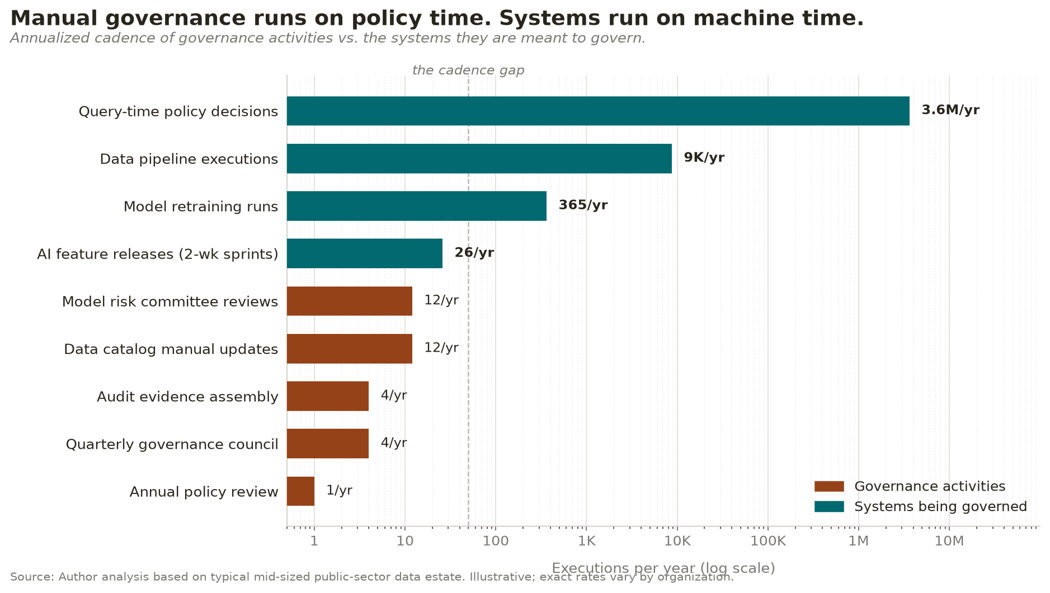
Figure 1. The governance cadence gap. Traditional governance activities are often measured in months and quarters, while modern data pipelines and AI systems operate in seconds and minutes.
A Practical Definition of Automated Governance
Automated governance is the practice of expressing data and AI policies as code, executing those policies against live systems, and generating audit-ready evidence as a byproduct of normal operations.
This definition has three implications for technology leaders. First, policies must become machine-readable, not merely human-readable. A policy that says sensitive data must be protected is important. A policy that automatically detects sensitive data, applies classification, restricts access, and logs exceptions is operational.
Second, controls must run continuously rather than only during annual reviews, pre-production assessments, or audit preparation cycles. Risk does not wait for the next governance meeting.
Third, evidence must be captured automatically. If an organization must reconstruct who approved a model, what data it used, whether a control fired, or how an exception was resolved, its governance evidence is already incomplete.
This does not require a single monolithic platform or an enterprise-wide transformation program before value can be realized. It requires treating governance as an engineering discipline—supported by versioning, testing, deployment pipelines, clear ownership, and measurable controls.
Five Controls That Belong in the Pipeline
Not every governance activity should be automated, and not every automation justifies the engineering effort. However, five control areas consistently provide a high-value starting point because they establish visible, testable evidence that governance is working.
| Control | Business Purpose | What It Looks Like in Production |
| Metadata capture | Establish visibility and accountability | Every pipeline emits schema, ownership, sensitivity classification, and lineage information as part of execution. |
| Policy-as-code | Enforce rules consistently | Access, retention, privacy, and permitted-use policies are expressed as executable rules and evaluated at runtime. |
| Continuous data quality | Prevent unreliable data from driving decisions | Quality rules operate as data contracts; failures trigger alerts, block downstream use, or open incidents automatically. |
| Model risk registration | Ensure AI systems are known, assessed, and accountable | A model cannot enter production unless its purpose, data lineage, evaluation results, risk tier, and oversight design are recorded. |
| Evidence generation | Reduce audit burden and improve trust | Control executions, approvals, exceptions, and remediation actions are recorded in tamper-resistant, queryable evidence stores. |
How public-sector organizations can turn governance policy into executable, auditable controls across the data and AI lifecycle.
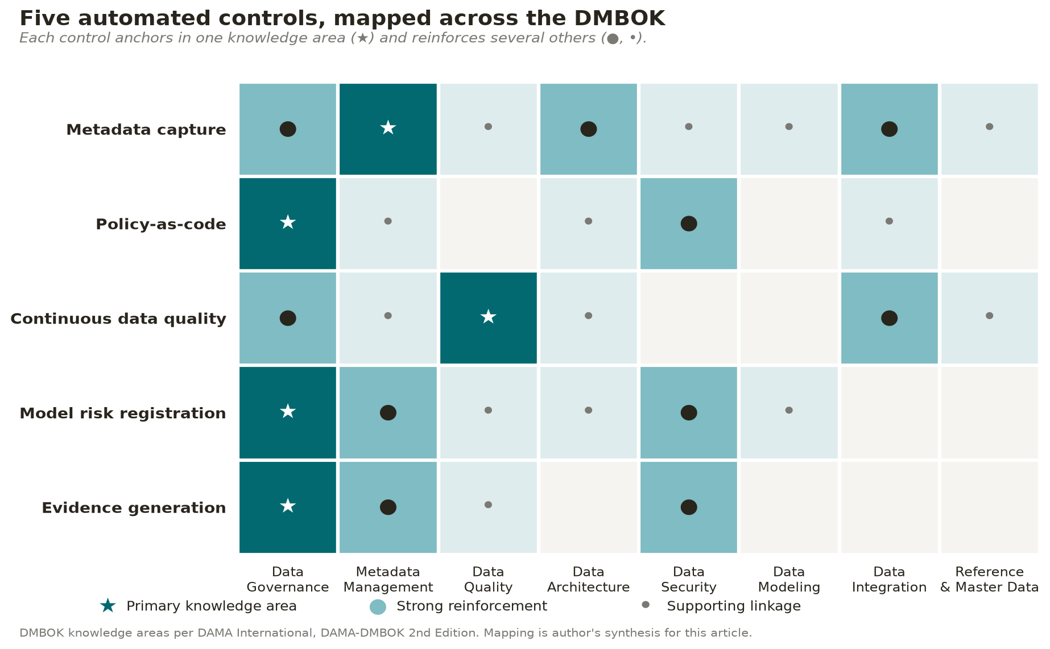
Figure 2. Automated AI governance controls create a connected enterprise capability: metadata, policy enforcement, data quality, model accountability, and evidence generation reinforce one another.
These controls are interconnected. Metadata enables lineage. Lineage supports explainability. Explainability improves incident response and model oversight. Policy-as-code enforces approved use. Evidence generation demonstrates that controls operated as intended.
For CIOs, the important insight is that governance is not a compliance layer applied after technology decisions are made. It is an enterprise capability that improves the reliability, security, and business value of data and AI investments.
Make Metadata a Byproduct, Not a Chore
Many data catalogs fail for a simple reason: keeping them current becomes someone’s part-time job.
The solution is not to ask people to be more disciplined. It is to instrument the systems that already know the relevant information. Ingestion frameworks, transformation tools, workflow orchestration platforms, data warehouses, business intelligence tools, and AI application pipelines should publish metadata automatically as they operate.
At a minimum, organizations should capture:
- Dataset name, owner, steward, and business purpose.
- Source system and downstream dependencies.
- Sensitivity classification and privacy attributes.
- Schema changes and data-quality signals.
- Transformation history and lineage.
- Approved users, access patterns, and retention rules.
For AI use cases, metadata is even more critical. A model’s behavior cannot be meaningfully explained if the organization cannot identify the origin, quality, classification, or permitted use of the data involved in training, retrieval, or inference.
Lineage is not merely a technical convenience. It is the foundation for explainability, incident investigation, compliance response, and accountable decision-making.
Move From Policy PDFs to Policy-as-Code
Many enterprise policies describe requirements that are, in fact, decidable questions:
- Is this user authorized to access this data?
- Is this dataset permitted for this AI use case?
- Has this information exceeded its retention period?
- Can this model process personally identifiable information?
- Has the required review been completed before release?
- Does this request violate a geographic, contractual, or regulatory restriction?
When organizations depend on people to remember and manually apply these rules, outcomes become inconsistent. Under pressure, even experienced teams may bypass steps or interpret policies differently.
Policy-as-code changes the operating model. Governance teams define the policy intent. Security, data, platform, and application teams translate that intent into testable rules. The rules are versioned, deployed, monitored, and reviewed just like other production code.
For example, rather than maintaining a policy statement that says “restricted data may only be used by authorized personnel for approved purposes,” an organization can deploy runtime rules that evaluate identity, role, data classification, purpose of use, location, and approval status before access is granted.
That shift turns governance from an advisory function into a measurable control environment.
Treat Data Quality as an Operational Contract
Data-quality dashboards are useful, but dashboards alone create observers. Enterprise accountability begins when quality rules are treated as contracts between data producers and data consumers.
A practical data contract defines expectations such as:
- Required fields and valid formats.
- Acceptable null rates.
- Permitted value ranges.
- Timeliness and freshness thresholds.
- Volume expectations.
- Schema-change procedures.
- Ownership and remediation responsibilities.
When a contract fails—for example, because of a schema drift, a sudden decline in source-system completeness, or an unexpected distribution shift—the organization should not merely display a warning on a dashboard. It should trigger a defined response.
Depending on the risk level, that response may include pausing a downstream pipeline, preventing a report refresh, blocking an AI workload from using the data, opening an incident ticket, notifying an owner, or documenting a time-bound exception.
This approach is especially important for AI systems. Inaccurate, incomplete, biased, stale, or improperly classified data can create outcomes that are difficult to detect after a model has already influenced a business process or public-facing decision.
Make the Model Registry Enforceable
A spreadsheet listing AI models is not a model-governance program. A registry becomes a control when production infrastructure refuses to route traffic to models that are unregistered, unapproved, expired, or inconsistent with their declared purpose.
An effective model-registration record should capture:
- Business owner and technical owner.
- Intended use and explicitly prohibited uses.
- Data sources, training-data lineage, and retrieval sources.
- Model version and deployment environment.
- Evaluation methodology and performance metrics.
- Security, privacy, and risk assessment results.
- Human-oversight design and escalation procedures.
- Risk tier and required review cadence.
- Approval status, exceptions, and expiration date.
Risk tiering allows organizations to apply proportionate oversight. An internal summarization assistant for low-risk administrative material should not carry the same governance burden as a system that influences hiring, eligibility, fraud detection, healthcare, credit, law enforcement, or other high-impact decisions.
The principle is straightforward: higher potential impact requires stronger evidence, more rigorous testing, clearer human accountability, and closer monitoring.
Generate Evidence Through Operations
For many leaders, the most visible benefit of automated governance is the reduction of audit preparation effort. More importantly, it changes the quality of the evidence itself.
Instead of assembling screenshots, email threads, approvals, spreadsheets, and retrospective narratives when an audit or incident occurs, the organization can retrieve an evidence trail from normal operations.
That evidence may include:
- The policy version in force when a decision was made.
- The result of each automated control check.
- Approval and exception workflows.
- Model and dataset ownership records.
- Quality-rule outcomes and remediation actions.
- Data-access logs.
- Deployment records.
- Monitoring results and alerts.
- Evidence of periodic reassessments.
When an executive, auditor, regulator, customer, or member of the public asks, “How do you know this system was governed appropriately?” the organization should be able to answer with verifiable operational evidence rather than a retrospective explanation.
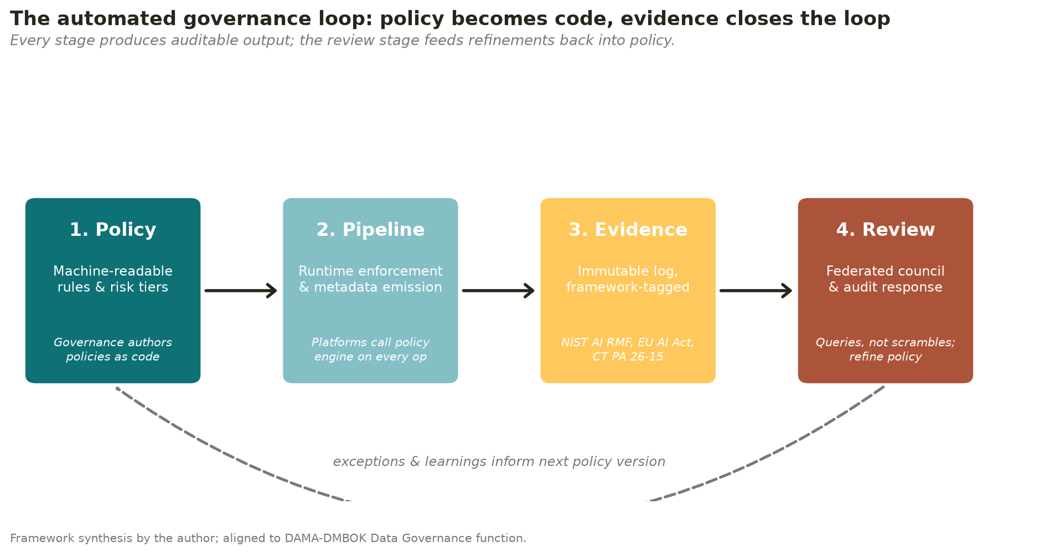
Figure 3. The automated governance loop: policy becomes executable code; execution generates evidence; evidence informs the next policy and control improvement cycle.
The Operating Model: Federated With Clear Guardrails
Automated governance works best when it combines enterprise guardrails with domain-level accountability.
A fully centralized approach often becomes a bottleneck. A fully decentralized approach creates fragmentation, inconsistent controls, and unclear accountability. The more resilient model is federated: central teams establish standards and shared platforms, while domain teams operate controls close to the data, products, and business decisions they understand best.
Central enterprise responsibilities should include:
- Defining the policy catalog and minimum control standards.
- Establishing the AI and data risk-tier taxonomy.
- Operating shared capabilities such as metadata services, policy engines, model registries, and evidence repositories.
- Defining identity, security, privacy, and audit integration patterns.
- Managing escalation paths for material exceptions and control failures.
Domain teams should own:
- Data-product quality and fitness for purpose.
- Dataset and model ownership.
- Local data contracts and business definitions.
- Remediation of quality, access, and policy-control failures.
- Prioritization of governance improvements based on business impact.
This division of responsibility enables scale. Central teams create consistency and reusable services; domain teams bring the context required to apply them effectively.
A CIO’s Monday-Morning Starting Plan
Automated governance does not need to begin as a multi-year transformation program. The most effective organizations start with a focused use case, demonstrate operational value, and expand from there.
Three practical moves can begin immediately.
- Instrument one high-value data product end to end. Choose a dataset supporting a critical report, service, operational decision, or AI use case. Capture lineage, ownership, classification, access activity, and data-quality signals automatically. Route the resulting evidence to a location that can be queried.
- Convert one policy into executable rules. Select a policy currently enforced through manual diligence, such as retention, access restrictions, or approved AI use. Implement it in a policy engine or through platform controls. Measure how often the rule fires and how often exceptions occur.
- Apply a risk-tiering rubric to the current AI portfolio. Classify AI systems by impact, data sensitivity, decision criticality, autonomy, and external exposure. This will quickly identify where stronger oversight is essential and where lightweight controls are sufficient.
These are achievable steps, each capable of producing measurable outcomes within a quarter. They also create a concrete demonstration for executive leadership: governance is not slowing delivery; it is enabling safe, repeatable, and scalable adoption.
Closing the Governance Gap
The organizations that will lead in the AI era will not be those with the most policy documents. They will be those that can consistently connect policy to execution.
For CIOs, automated governance provides a practical way to align innovation with accountability. It helps ensure that data and AI systems are secure, explainable, reliable, and ready for scrutiny. It reduces manual overhead while improving evidence quality. Most importantly, it makes trust operational.
The goal is not to create a perfect governance system before deploying AI. The goal is to establish controls that improve continuously as the organization learns, scales, and encounters new risks.
When governance becomes part of the pipeline, trust stops being a promise and becomes a capability.
Explore more articles
Your AI Was Replaced Overnight. Would You Have Noticed?
In Conversation with Raúl Nogales, Founder and CEO, AVAP

Gopichand Mannava, M.Eng., MBA, PMP, is Chief Data Architect for the State of Connecticut and an independent researcher working at the intersection of trustworthy AI, enterprise data architecture, cybersecurity, and public-sector digital transformation. He designs and advances the data, governance, and assurance foundations that enable complex public institutions to use analytics, automation, and AI securely, transparently, and responsibly—supporting reliable services, responsible stewardship of public resources, and better outcomes for Connecticut residents.