
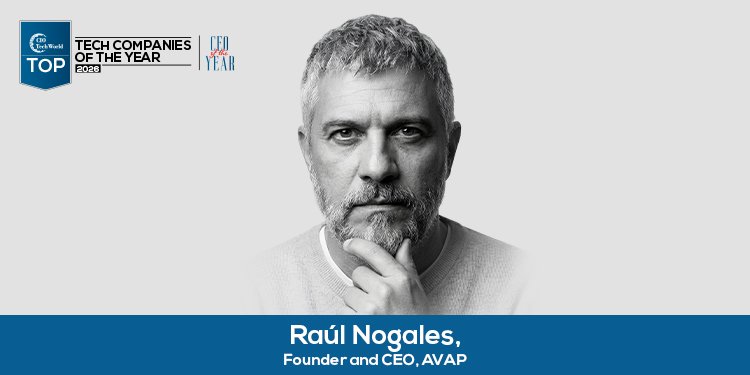
“I am still that kid at heart who, at the age of ten, was programming in BASIC and experimenting with assembly language on an 8-bit home computer,” says Raúl Nogales, Founder and CEO, AVAP. From working with 8-bit MSX HitBit 101P in the 80s to 64-bit mainframes in the early 2000s as a Fintech professional, Raúl retained his kid-like zeal for programming. In fact, he says that his passion for programming continues to grow as he watches technology, under the banner of API first and then AI, change the world.
After more than a decade in corporate financial technology, Raúl left to build on his own. He had worked on international payment projects including MobyPay in Spain and mPesa in Kenya, where he first became involved in the world of financial inclusion, and on Hal Cash, which let people withdraw money from an ATM by phone without a card or a bank account. In 2008, in the middle of Spain’s banking crisis, he moved to Mexico to launch it there, alongside partners such as ING and Caixa Galicia, among other leading Spanish banks. A decision he still calls the one that determined everything that followed. It led instead to Pademobile, a digital banking platform built around financial inclusion, which reached five million registered users and a $250 million valuation in Silicon Valley by 2015, subsequently validated by Banco Santander Mexico.
The exit of Hal Cash and Pademobile gave Raúl something most founders spend a career pursuing: time, capital, and the freedom to build whatever he wanted next. The obvious move was another fintech venture. Why not, as he had the track record. He chose instead to build a programming language, chasing his lifelong passion. “I needed to create technology,” he says. “Not management software. Not another platform designed to revolutionize a particular market.”
But turning that vision into a new technology required far more than an idea. Throughout that journey, Raúl worked closely with Rafael Ruiz, AVAP’s CTO, with whom he co-developed the technology that would ultimately become AVAP. While he drove the vision and recognized the need for a new paradigm in software development and programming, Rafa played a fundamental role in bringing that vision to life through its technological conception and development. Together, they shaped what AVAP is today: a technology built from the language up for a new generation of software.
By the early 2010s, Raúl had been watching software development move toward microservices and API-based architectures, where applications are broken into dozens of smaller, independent services that communicate through internal APIs. The shift was profound enough that tech historians would later give it a name: the API Boom and the dawn of the API Economy. It also left Raúl with a more fundamental question. If APIs and microservices were becoming so central to the future of software, why was there no technology, and no programming language, conceived, designed, and built specifically for that purpose?
How could it be that there was HTML or Node for building websites; C and C++ for lower-level, machine-oriented development; and general-purpose languages such as Python and Java, but no programming language specifically designed for developing APIs?
 That question was the seed of AVAP (Advanced Virtual AI Systems Programming). It is the first virtual programming language designed for building microservices, which, at that time, had one primary technical application: APIs. And its role was about to change in the ‘AI Boom’ that the 2020s witnessed.
Raúl founded 101OBEX in 2020, at the height of the COVID-19 pandemic, to bring the technology to organizations. The launch had been designed for normal circumstances; the company ended up building the entire project in conditions nobody had planned for. “I have hope that AVAP could earn us a tiny place in history, the space occupied by a single bit in the history of computing,” he says. This year, API World named the company Best Innovation in API Gateway 2026 for redefining the API ecosystem and enabling the next generation of intelligent, connected software. The recognition follows Kong as the previous category leader, marking AVAP’s emergence as a new technology in the API ecosystem.
Now, the company rebranded to take the name of the language it had built: AVAP.
AVAP: From APIs to AI Systems
AVAP had been built to make backends more dynamic, allowing them to evolve without constantly having to rebuild and redeploy the entire system; a process that can consume roughly 30% of software development budgets. As AI and autonomous agents began interacting continuously with APIs, enterprise knowledge, and running systems, Raúl realized that the same quality was also the right foundation for building and operating AI Systems, intelligent backends, a new software architecture. “APIs have evolved from integration tools into the core infrastructure powering AI-native applications, autonomous agents, and intelligent digital experiences,” he says and adds, “Also, MCP servers, the connector blocks for AI, at their core, are APIs. Without APIs, there is no AI. Without APIs, there is nothing.”
I have hope that AVAP could earn us a tiny place in history, the space occupied by a single bit in the history of computing.
This architecture addresses the confusion that is prevailing in the market today: an AI solution is reduced to a system that consumes the API of ChatGPT, Claude, or another model. Raúl says that these are just wrappers around ChatGPT or Claude, which are fine for a demo and not dependable for handling business processes. Putting AI into a PowerPoint is easy. He argues that the scenario is extremely risky. Because, ultimately, these AI solutions can be replicated by almost anyone in a very short period of time, leaving organizations with a business that is completely dependent on someone else.
AI Systems, as AVAP defines it, is not an application with a chatbot attached but an intelligent environment where business capabilities, APIs, MCP (Model Context Protocol) servers, enterprise knowledge, AI agents, and governance mechanisms operate together as a single coordinated system. In this architecture, AI is no longer an isolated feature. It becomes the execution layer that continuously orchestrates how software behaves.
That matters because the next generation of software consumers will not be people alone. They will be intelligent agents capable of understanding objectives, reasoning, planning, and autonomously executing complete business processes. The model becomes the operating environment for the AI that collaborates with humans to operate the business.
“We are talking about an architecture conceived from the language level to build and operate AI Systems. That, in my opinion, is our greatest advantage,” says Raúl. While others are adding AI capabilities to infrastructures that were designed for a different paradigm, AVAP is building the infrastructure for the paradigm that comes next.
Since then, Raúl has led the technological evolution of the language and its underlying architecture alongside Rafael. The combination of Raúl’s product and business vision with Rafael’s deep technical expertise has enabled AVAP to evolve from a response to the challenges of APIs into a technology designed to build and operate intelligent backends.
We are talking about an architecture conceived from the language level to build and operate AI Systems. That, in my opinion, is our greatest advantage.
AI Systems is a departure from more than three decades of building applications for human users alone. In this architecture, capabilities are meant to be discovered, reasoned about, and executed by AI and humans collaboratively. So, AVAP is designed not only for people, but also for AI.
Raúl has spent his career on the developer’s side of the technology, and it shows in the design. New tools, he argues, are usually shaped around what the system can do, what the business needs, or where the market is heading, and only rarely around the person actually building with them. AVAP puts that person back at the center, removes unnecessary complexity, and makes it possible to build systems in a more natural, dynamic, and efficient way.
Two Layers, One Stack
Raúl and Rafael say that AI Systems requires far more than AI models to realize its transformative benefits. The software architecture demands a technology stack purpose-built to structure software for AI interaction, manage its entire lifecycle, and enable intelligent operations.
AVAP provides this foundation through two fully integrated technologies: AVAP and Brunix.
 At the foundation of the stack is AVAP, a programming language specifically designed for building intelligent backends. Its specific capabilities come from what sits underneath it: PLATON, an open-source virtual programming language kernel. It is the core layer that manages system resources and connects software to hardware. PLATON is what makes it possible to create purpose-specific virtual languages like AVAP and have them work with any product that supports the technology.
Because it is open source, customers are not locked into a proprietary runtime they cannot inspect or audit, a distinction that matters considerably to regulated enterprises. AVAP was the first language built on it, and the proof that the model worked.
Technology is going to continue changing at an extraordinary pace. We do not want our customers to have to rebuild their technology every time a new paradigm emerges. We want them to have an architecture that can evolve with it.
AVAP, as the AI Systems Lifecycle Management Platform, provides the operational environment required to design, deploy, orchestrate, govern, and continuously evolve this environment at enterprise scale.
The platform enables organizations to transform collections of APIs, services, tools, and capabilities into secure, governed, AI-native ecosystems where both humans and intelligent agents can collaborate efficiently and safely.
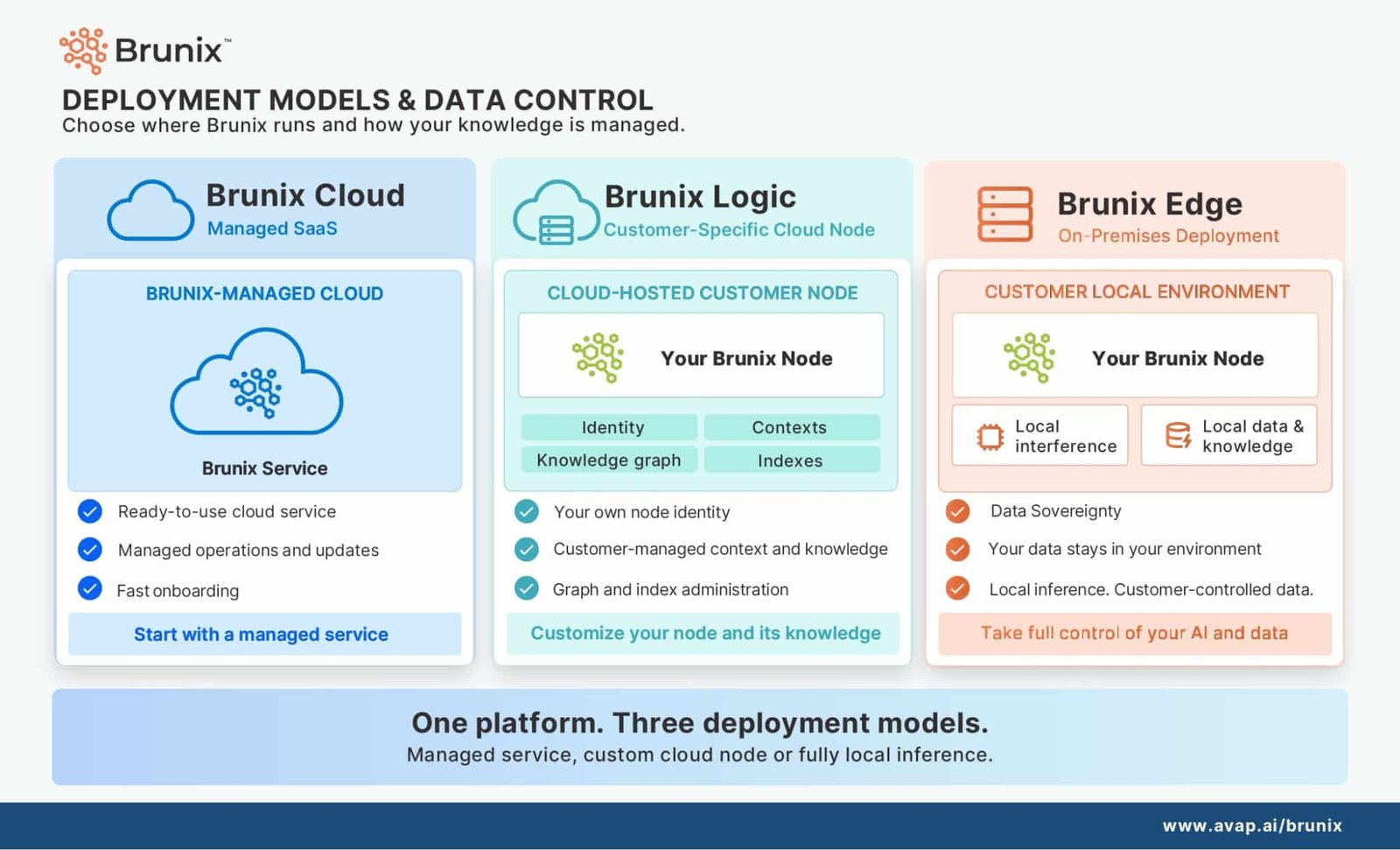
Brunix is the artificial intelligence layer that brings intelligence to the architecture of intelligent backends. Within AVAP, it understands the platform’s functional capabilities, its operating model, and the lifecycle of the AI Systems built and managed on it. This platform intelligence enables it to assist in the design, generation, deployment, evolution, and operation of complete intelligent backends. Users can give Brunix a functional specification, and it can create the complete AI System required, deploy it to production, and make it available for consumption.
It is not simply about providing knowledge for building and operating AI Systems. Brunix allows users of AI Systems to have their own AI, with knowledge of their specific system, both in the cloud and at the edge.
Brunix is also how customers keep control of their own knowledge. It operates in the cloud but is built around a distributed knowledge architecture, so each organization can have its own Brunix, with its own identity, holding the data and knowledge of its AI System either in the cloud or on its own premises. The edge side is powered by Brunix AIOS, with its Lezo version certified for NVIDIA Tegra hardware, enabling AVAP to run AI systems directly at the edge. That solves something the market largely has not: a bank, a hospital, or a government agency no longer has to choose between running modern AI infrastructure and keeping its data inside its own walls. “On-prem is not a compromise. It is a first-class deployment,” says Raúl.
Together, both these technologies form the foundational platform for the AI Systems Era, where programming, lifecycle management, and AI converge to create AI-native software systems designed for seamless collaboration between people and intelligent agents.
Why Marcial Pons Left SAP and Chose AVAP
Because AVAP is designed to build and operate intelligent backends, AVAP inherently has cross-industry clients. The company works with financial institutions, insurance providers, and players in other sectors, including publishing.
In that context, one of the most recent projects AVAP is working on is with the Spanish company Grupo Empresarial Marcial Pons, one of the leading legal publishers in Spain and Latin America.
Marcial Pons was concerned about its technology strategy, the cost of maintaining its existing technology, and the level of service it was receiving. But more importantly, it was concerned about whether its technology was truly evolving alongside the business and providing the support the business needed.
After evaluating its options, Marcial Pons entered into a strategic agreement with AVAP to implement and operate its entire technology environment.
“For a third-generation family business like Marcial Pons, with a long and solid track record in the publishing industry, technological evolution is not simply an adaptation to innovation, but a strategic decision for the sustainable development of the business. Our investment in AVAP allows us to build a more efficient, more flexible, and future-ready technology infrastructure. At the same time, this process enables us to achieve very significant cost savings from the outset,” says Marta Pons, Managing Director, Marcial Pons.
“Marcial Pons is obviously in the best position to explain why it made that decision. But for us, as a young startup, having a customer that is so convinced of the technology and so clear about its commitment is an enormous achievement,” declares Raúl .
Marcial Pons made the decision to move away from SAP, an undisputed global leader in the ERP market, and build its AI system with AVAP and Brunix.
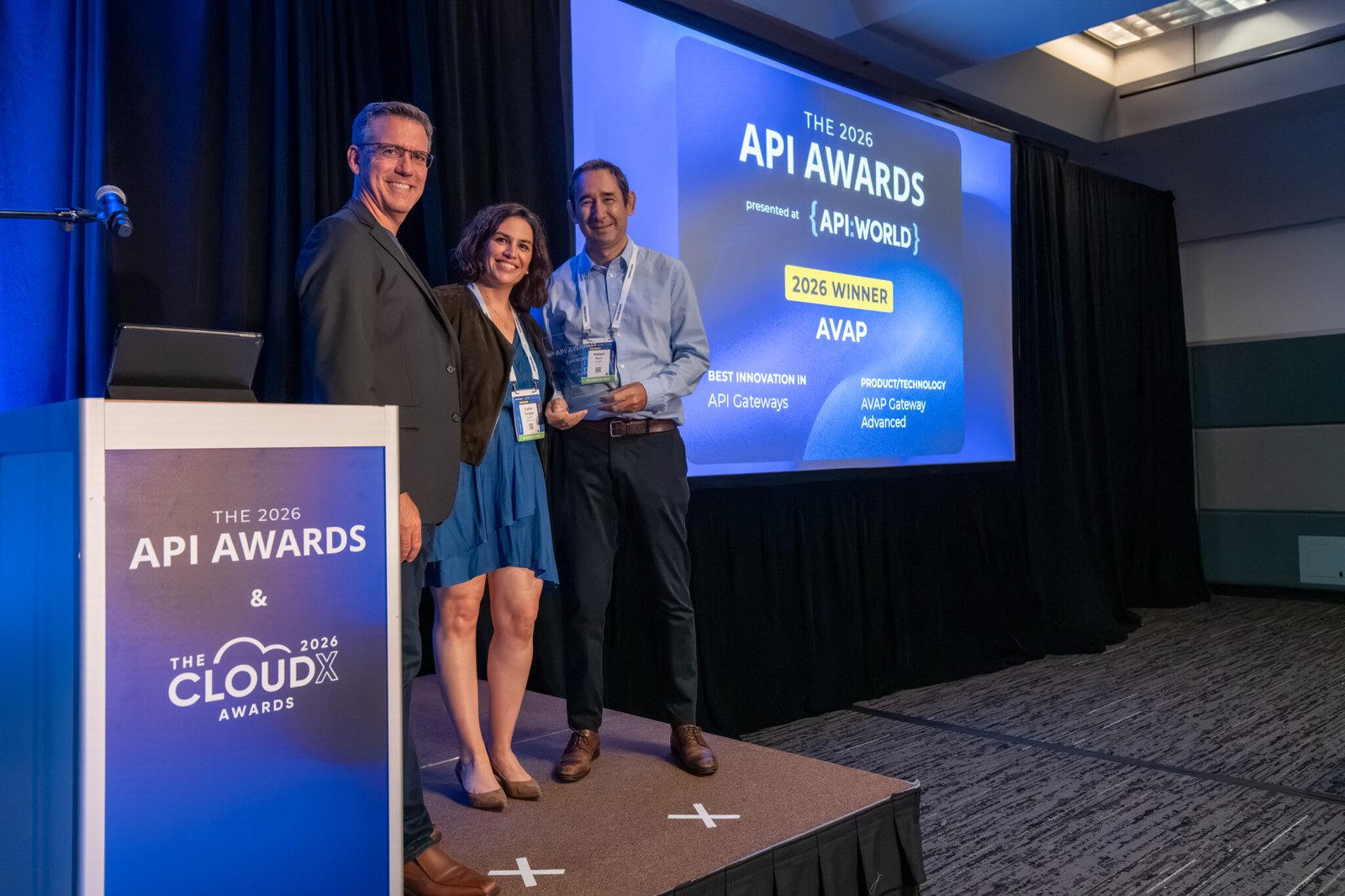 Raúl says that, for AVAP, this is a tremendous success, a source of great pride, and also a huge responsibility, particularly because, until now, its customers have been on the other side of the Atlantic, in Mexico and the United States, making this its first flagship project in his native Spain.
He also says that AVAP has already cut the publisher’s infrastructure, licensing, and operating costs, and is targeting a 65% reduction in the publisher’s annual technology spend. The company is continuing to make progress toward its goal of starting 2027 with the complete system up and running and managed by a hybrid team of AI and people.
“But beyond this particular case, what we are achieving with AVAP is enabling our customers to build and evolve their systems much faster, with greater flexibility and efficiency,” says Raúl.
AVAP reduces customers’ dependence on traditional infrastructure and licensing models, simplifies operations, and lets software evolve at the same pace as the business – without a continuous rebuild of the underlying architecture.
And this is where AI becomes particularly important. With AVAP, intelligence and automation can be incorporated natively into the architecture, making it possible for systems not only to execute processes, but also to understand, decide, act, and evolve.
For the AVAP customers, this translates into a lower total cost of ownership, faster development and time to production, greater adaptability, and, above all, an architecture designed to build and operate this way without having to start over every time the technology changes. “That last point is particularly important to me,” says Raúl.
“Technology is going to continue changing at an extraordinary pace. We do not want our customers to have to rebuild their technology every time a new paradigm emerges. We want them to have an architecture that can evolve with it,” he remarks.
The Next Chapter
“Over the coming years, the traditional boundaries between software development, operations, and data will gradually disappear,” says Raúl. “Systems will evolve continuously through collaboration between people and AI agents, while governance, observability, and enterprise knowledge become intrinsic parts of the architecture itself.”
The conversation will also shift. Instead of asking which model to use, organizations will ask how to build systems capable of learning, adapting, and continuously evolving without losing control of their knowledge or their business processes.
Knowledge graphs and inference workflows will become central architectural elements, Raúl says, and the platforms that make these systems easy to design, govern, and evolve will define the next generation of enterprise software. “That, to me, is the true meaning of AI Systems,” he states.
AI Systems is not simply another category of software. It represents the next stage in the evolution of software engineering itself. “And I am convinced that technologies like AVAP and Brunix will help lead that transition,” concludes Raúl.
Explore more artciles: