



A green dashboard can hide a struggling workflow.
The monthly AI review looks encouraging: more eligible staff are using the tool and prompt volumes are rising. The organization is preparing to expand it. Yet the dashboard cannot show whether the underlying service has improved.
Then someone asks what happened to the work itself.
In one illustrative service workflow, 200 completed cases tell a less comfortable story. Handling time is unchanged. Reviewers correct 31 answers before release, and 14 customers return because the first answer is incomplete or wrong. The service desk creates a new incident category for faulty outputs. None of that appears on the adoption dashboard.
This is a composite scenario, but the measurement problem is ordinary: organizations count the activity that is easiest to see and miss the effort that has moved elsewhere.
Usage matters, but it answers a narrow question: are people touching the system? It does not tell a CIO whether the organization is completing work faster, making sounder decisions, creating less rework, or improving the outcome for the person at the end of the process.
The useful unit of measurement is therefore not the licence, prompt or model response. Start with an eligible request or need, then reconcile it with what happened: completion, rejection, diversion, abandonment, repeat contact, or an unresolved outcome.
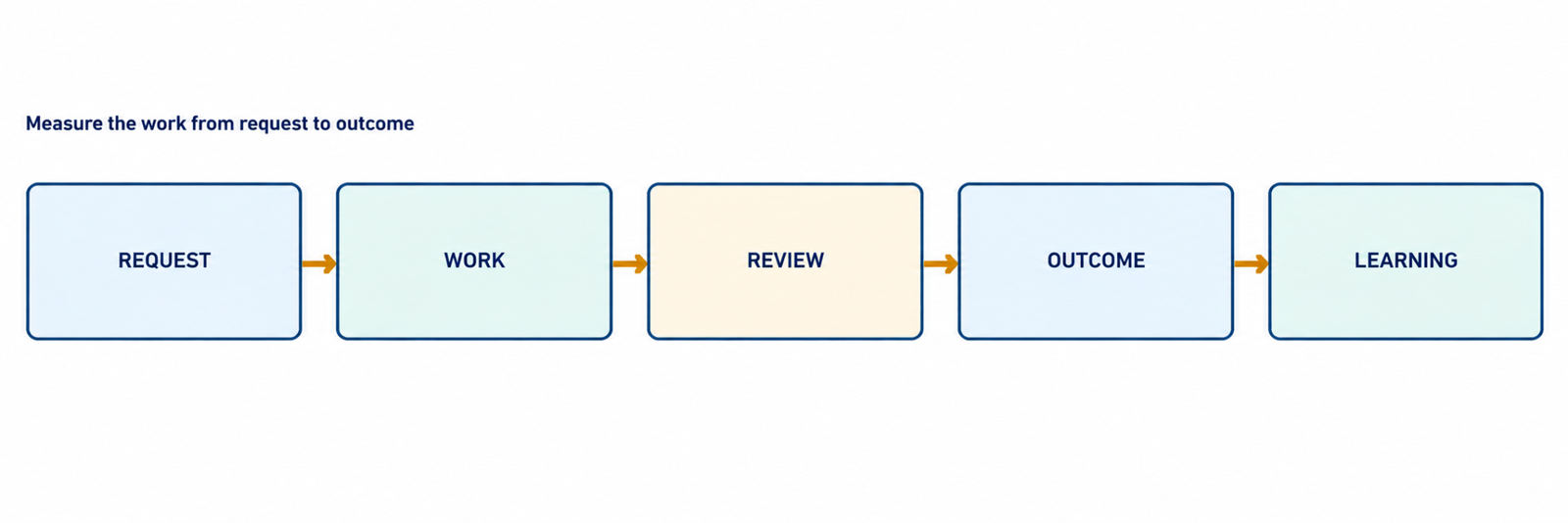 Figure 1. A measurement chain that follows the work, not the software.
Six questions for the post-AI pilot review
-
Our usage is growing. Why is that not enough?
Growing use proves that people can access the tool. It does not show whether eligible work is completed better. Some staff may restrict it to low-risk tasks; frequent users may also spend substantial time checking or repairing its output.
Keep usage on the dashboard, but label it honestly. It measures reach. Pair it with evidence from the workflow: completion time, quality at the point of use, corrections, downstream rework, and the result experienced by the customer or colleague.
-
What should the unit of measurement be?
Choose a unit the business already recognizes: a customer request, an invoice, a risk review, a replenishment need or a loan application. Start with all eligible demand, not only the cases the system completes. Follow each item through rejection, channel switching, review, correction, and any later return.
This boundary matters. If a demonstration claims that drafting time falls from thirty minutes to thirty seconds, count the reviewer’s ten minutes and any later customer contact before recording the saving.
-
How do we measure decision quality when there is no perfect answer?
Do not force every decision into a single accuracy score. Use evidence suited to the decision: expert sampling, reversals, upheld appeals, complaints, later corrections, and outcomes observed after enough time has passed. Record uncertainty when the result is genuinely contested.
Human decisions also contain error and inconsistency. Compare the AI-supported workflow with the actual human baseline, segmented by material case type and affected group, and judge whether any improvement is worth the remaining risk.
Report the result by material case type and affected group. A favorable average should not justify expansion if high-consequence cases experience more delay, reversals or harm.
-
Where do hidden costs usually appear?
Look at the exception path. Staff may copy answers into another system, maintain a private spreadsheet, ask an experienced colleague to check difficult cases or quietly redo work after the formal process says it is complete. These repairs often sit outside the AI budget.
Engineering should continue tracking model and infrastructure costs, but the executive measure should include review, correction, support, repeated contact, and downstream rework for each satisfactory outcome. It should also show whether that burden is concentrated on a few experienced people, pushed into overtime, or displacing another queue.
Give staff a confidential route to disclose workarounds. Do not use those disclosures for performance management unless deliberate misconduct is established independently. Record what risk the workaround prevents, what new risk it creates, and why the formal process could not carry the work.
-
What belongs on the CIO’s scorecard?
A useful scorecard connects technical performance to operational consequence. Each measure needs a fixed definition and denominator, a baseline, an owner, a review cadence, and a threshold agreed before the result is known.
| Executive measure | Definition and evidence | Owner, cadence and threshold |
| Demand to satisfactory outcome | All eligible requests reconciled to completion, rejection, diversion, abandonment or unresolved demand; segment by case and affected group | Business process owner; monthly; investigate any missing demand or deterioration beyond the agreed tolerance |
| Quality and harm | Material corrections, reversals, repeat contact, delay and severity; use independent sampling rather than reviewer acceptance alone. | Risk owner; monthly and after incidents; one severe breach may pause immediately |
| Full effort and cost | Technology, implementation, control, review, interruption, exception, support and downstream correction per satisfactory outcome | Finance and operations; monthly; breach when full cost exceeds the approved range |
| Net realized value | Attributable benefit realized minus full incremental cost and attributable loss; saved minutes count only when capacity is used. | Business sponsor; quarterly; scale only when evidence clears the value hurdle |
| Recovery and exit | Fallback performance, open-case containment and ability to correct, narrow, pause or retire | Service owner; tested quarterly; any containment failure triggers action |
Scorecard design draws on the NIST AI Risk Management Framework’s emphasis on context-appropriate measurement, production monitoring and regular review, and the GAO framework’s links between performance, program objectives and ongoing monitoring.
-
When should the organization redesign, pause or retire the system?
Agree the triggers before the dashboard becomes politically important. For each trigger, state the observation window, affected case class, acceptable rate, decision owner and maximum investigation time. Keep frequency triggers separate from severity triggers: one privacy disclosure, unsafe instruction, or wrongful high-impact decision may justify immediate containment.
Name the role authorized to stop the live workflow. The response plan should cover open cases, notification and remedy for affected people, evidence preservation, an escalation deadline and the approval needed before restart.
The decision need not be binary. Some cases can remain automated while higher-risk or poorly evidenced cases return to a different route. What matters is that someone owns the decision and the scorecard leads to action.
A worked scorecard: faster work, weaker evidence for expansion
This composite uses two four-week periods with 1,000 eligible service requests in each. In the AI pilot period, 890 reach a satisfactory outcome, 35 are abandoned or diverted, 45 remain unresolved, and 30 lack a linked outcome. The unit-cost denominator is the 890 satisfactory outcomes.
The team matches results by channel and complexity. Approximate 95% intervals place first-pass quality at 87-91% and repeat contact at 11-15%; both remain outside the agreed thresholds even if every missing outcome is favorable. Cost allocation sensitivity is A$14.80-A$15.50. One analyst moved teams during the AI pilot, so the observed changes are treated as associations rather than effects caused by AI. High-consequence cases are reported separately but are too few to support expansion.
| Measure | Baseline to AI pilot | Threshold and reading |
| Completion speed | Median 2.4 to 1.8 days; 90th percentile unchanged | Median improves, but difficult cases do not |
| First-pass quality | 94% to 89% accepted without material correction | Fails the pre-agreed floor of 93% |
| Repeat contact | 8% to 13% within 14 days | Fails the ceiling of 9%; check affected groups |
| Human effort | 9 to 11 reviewer minutes per eligible request | Correction is concentrated in two senior staff |
| Full unit cost | A$14.20 to A$15.10 per satisfactory outcome | No saving after platform, review and support costs |
| Net realized value | Attributable benefit cannot yet be established | Fails the scale gate; saved time was not shown to release usable capacity |
| Safety and recovery | No severe event; fallback test passes | No pause trigger, but this cannot override failed quality |
The service owner, with risk and finance review, should not approve expansion on this evidence. Keep the current scope, protect time for the two senior reviewers, and investigate the source of rework, testing stale data as one hypothesis. Repeat the comparison on matched cases. Scaling can be reconsidered only after quality, repeat contact, and full-cost gates pass.
The strongest objections: time, attribution and measurement behavior
Some outcomes cannot be judged quickly. A strategic decision may take months to assess. A risk decision may appear successful only because the feared event did not occur. Customer harm can be unevenly distributed and invisible in an average.
Where final outcomes take time, separate early indicators from later results. Track whether the required evidence was present, whether the decision followed the agreed process, whether a qualified person could challenge it, and whether later evidence changed the judgement. Then review the longer-term outcome at a cadence suited to the decision.
Attribution is a second problem. Demand, staffing, policy, or case mix may change during the AI pilot. Use a comparable workflow, phased rollout, or matched case sample where feasible, and record concurrent changes. Otherwise describe the result as an association, not value caused by AI.
Better measurement can create a third risk: excessive monitoring of workers. Prefer case-level evidence, limit collection to a stated purpose, restrict access and retention, and give staff a route to challenge interpretation. Exploratory measurement should not quietly become individual productivity ranking.
A 30-day exercise for one live workflow
Days 1-5: choose the work. Select one consequential, repeatable workflow. Define eligible demand, outcomes, owner and baseline. Name an operational sponsor and frontline lead, and allocate paid time for the review.
Days 6-12: trace a defensible sample. Select routine, exception, high-consequence and abandoned or returned cases from workflow records, not nominated successes. Add bounded, accessible, and confidential feedback from affected customers, including people who changed channels or did not complain.
Days 13-20: expose transferred effort. Add reviewer time, support work, repeated contact, exceptions, and downstream correction. Separate a model defect from bad data, weak process design, or unclear authority.
Days 21-26: agree the scorecard. Choose a small set of measures with definitions, denominators, owners, evidence sources and pre-agreed action thresholds. Have the process owner and an independent finance, risk or assurance participant agree what the evidence can support.
Days 27-30: make a decision. Maintain, repair, narrow, scale, pause, or retire the workflow. Record why, what will be checked next, and when the decision will be revisited.
| WHAT SUCCESS LOOKS LIKE AFTER 30 DAYS
A defensible decision record for one workflow: population, baseline, full cost, outcome, uncertainty, threshold, owner, and the resulting action. |
What changes in the executive conversation
The meeting becomes more useful when operational evidence sits beside model and adoption data. Leaders can see where exceptions accumulate, whether savings survive review and support, and which repairs formal reporting has missed.
A CIO does not need hundreds of measures. The harder task is choosing a small set that makes poor performance difficult to hide and gives the organization permission to correct course.
At the next post-AI pilot review, ask for the decision record for one live workflow. It should show the sampled cases, baseline, full cost, outcomes, uncertainty, thresholds, owner, and why the organization chose to maintain, repair, narrow, scale, pause, or retire it.
Sources and further reading
- NIST, Artificial Intelligence Risk Management Framework (AI RMF 1.0) and Core. Official source
- US Government Accountability Office, Artificial Intelligence: An Accountability Framework for Federal Agencies and Other Entities. Official source
- UK Department for Science, Innovation and Technology, AI Management Essentials guidance. Official source
Editorial note: The opening and worked scorecard are illustrative composites. No organization or measured result is represented. The article provides management guidance, not legal, financial or assurance advice.
Explore more articles by Mani Padisetti.
AI Adoption Fails After Launch. The Operating Model CIOs Forget
Human-in-the-Loop Is Not Enough: Where Is the Human Authority Line in AI-Supported Decisions?
Who Owns the Access Behind AI Agents and Automation?

My journey as the COO, vCIO, and Co-Founder of Digital Armor Corporation; Co-Founder and CEO of Emerging Tech Armory; and Curator, Almost Magic Tech Lab reflects my extensive experience and unwavering dedication to helping medium-sized businesses leverage technology for growth and success. With over two decades of founding and running my own company, I have established myself as a trusted expert in empowering SMBs to enhance productivity, scale effectively, and gain a competitive advantage in their respective industries.
I often refer to myself as the “Growth Catalyst for Mid-Sized Businesses” because I understand the unique challenges these enterprises face, such as limited budgets. I deliver tailored solutions that address their specific goals and constraints.
My secret ingredient to effective leadership is finding joy in being a catalyst for others’ success. I firmly believe in acting in the best interest of my clients, genuinely caring for their businesses as if they were my own. This client-centric approach forms the foundation of my leadership philosophy, driving me to go above and beyond to ensure my clients’ satisfaction and prosperity.